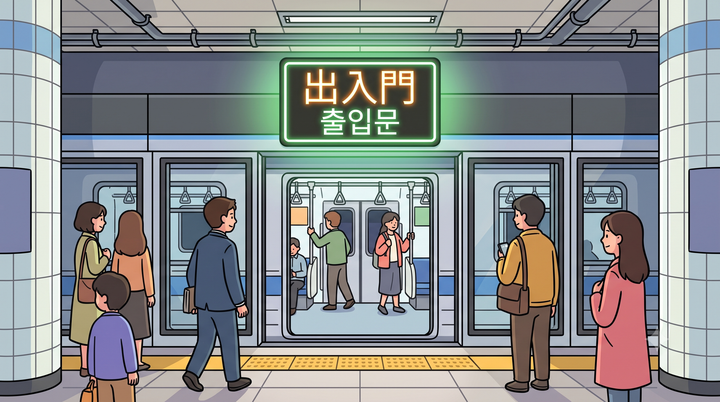
[Intern’s Log 📝] Four Characters, Big Meanings: Why Korean Idioms Say It Best
Explore essential Korean idioms and language tips in this fun, real-world guide designed to help you level up your language skills.

[Intern’s Log]
Welcome to our new series! 👋 Follow along as our American intern shares authentic first-hand experiences, cultural insights, and Korean language realizations while living in Seoul. 🏙️✨
Have you ever tried to express a really complex situation in English, only to realize Koreans have a single, four-syllable word for it? That’s where 사자성어 come in! 📜
Originating from Chinese characters (Hanja), these four-character idioms pack centuries of history, culture, and storytelling into short, punchy phrases. They pop up everywhere in daily Korean from news headlines 📰 to casual dialogue 💬.
Let’s explore a few of these expressions and when you may use them!
[✨Real-World Examples]
🐶🙉 견원지간
Two childhood rivals bump into each other on their way to work and immediately start arguing just like they used to. Two old friends spot them and realize some things never change.

The girls in this image may remark “쟤네는 어릴 때부터 견원지간이었어. (They’ve been at each others throats since they were young.)” after seeing the two men fighting. This remark means that the two men have been rivals since they were in school together and are still ‘at each other’s throats’. This could imply that they have always been competing against one another or that they are naturally opposites in personality which causes them to clash.
- Literal meaning: The relationship between a dog and a monkey
- Interpretation: In East Asian folklore, dogs and monkeys are traditionally viewed as natural adversaries that constantly quarrel whenever they cross paths. Therefore, 견원지간 describes an intensely hostile, irreconcilable relationship between two parties, akin to "sworn enemies," "like cats and dogs," or "at each other's throats."
- Hanja breakdown:
犬 (견): Dog
猿 (원): Monkey / Ape
之 (지): Possessive particle / modifier ('s, of)
間 (간): Between / Space / Relationship
🐉🐍 용두사미
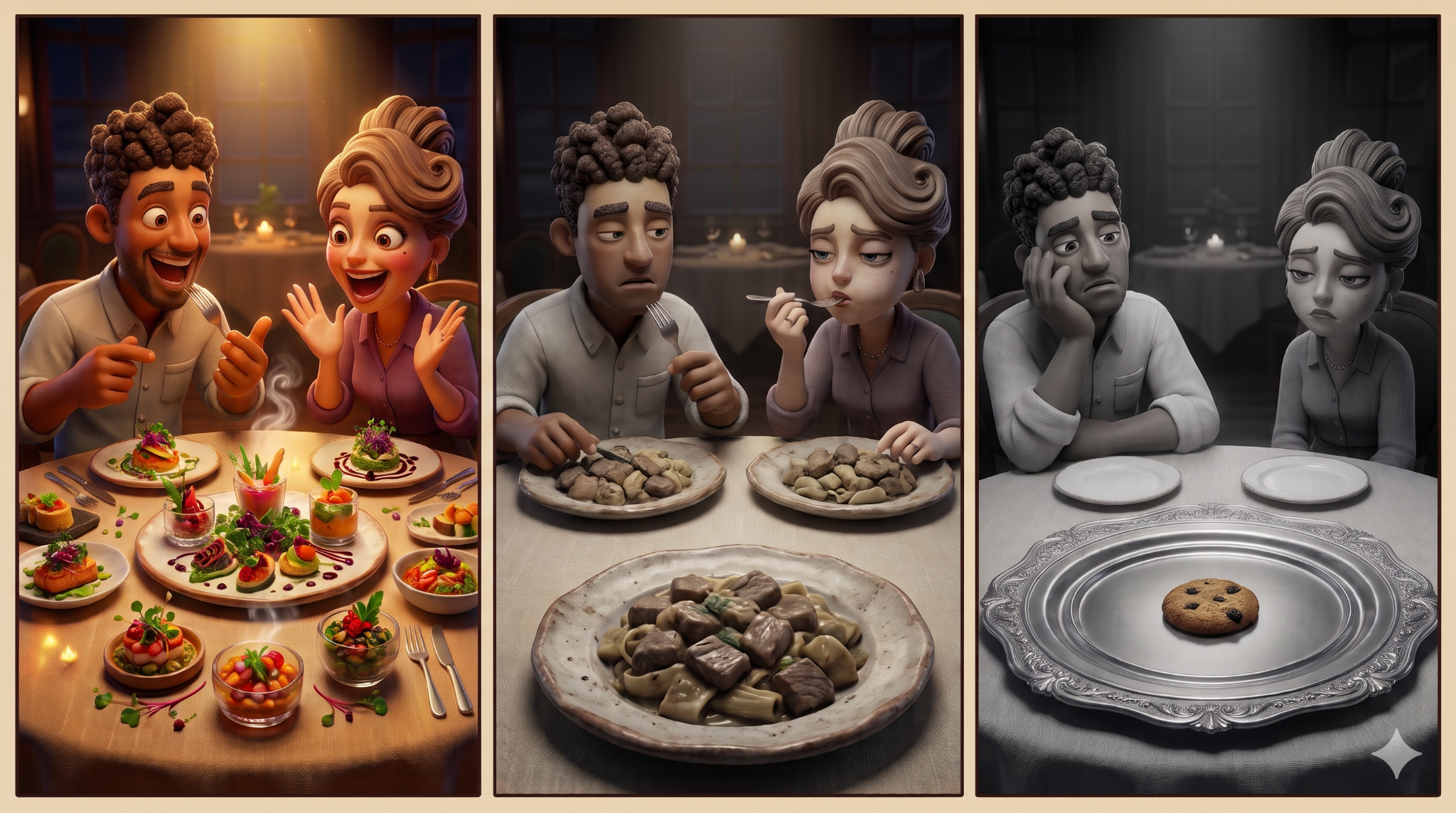
A couple goes to a high-end restaurant expecting an extravagant three-course meal. After the grand spread of the first course, the couple's expectations were high but in the end, it was very anticlimactic. The couple in the image may later recount this experience by saying “코스의 첫 요리는 굉장했는데, 뒤로 갈수록 맛이 없어서 용두사미로 끝났다. (The meal started out with an incredible first course, but as it went on, it lost flavor and ended on an anticlimactic note.)”
- Literal meaning: A dragon's head and a snake's tail
- Interpretation: It describes an endeavor that starts off with tremendous ambition, grandeur, or fanfare, but gradually fizzles out and concludes weakly or disappointingly. The English equivalent is "starting with a bang and ending with a whimper" or "an anticlimax."
- Hanja breakdown:
龍 (용): Dragon
頭 (두): Head
蛇 (사): Snake
尾 (미): Tail
🎯Your Turn: Challenge Yourself!
I will give you a scenario that fits one of the three idioms listed below. Your job will be to choose the one that fits best! Good luck~
The scenario is as follows:
Your small, tight-knit company is expecting a well-deserved internal promotion after a senior supervisor retires. Instead, the CEO shocks everyone by hiring his fresh-out-of-college nephew. You decide to give him the benefit of the doubt until the CEO walks out the door and the kid immediately begins barking orders, totally steamrolling your team's established workflow.

Take a look at the breakdown of each idiom below and make your pick!
🐦🍐 오비이락
- Literal meaning: This idiom describes a situation where a crow happens to take flight from a branch at the exact moment a ripe pear falls to the ground. The bird's departure did not actually cause the fruit to drop, yet an onlooker might immediately suspect the crow knocked it down.
- Interpretation: The idiom describes an innocent action that happens to coincide with an unfortunate event, leading to unwarranted suspicion purely due to bad timing. Common English equivalents include "mere coincidence causing false suspicion," "caught in the wrong place at the wrong time".
- Hanja breakdown:
烏 (오): 까마귀 오 - Crow
飛 (비): 날 비 - To fly
梨 (이): 배나무 이 - Pear
落 (락): 떨어질 락 - To fall - Example:
친구가 새로 산 키링을 보여 줬는데 내가 만지자마자 부러져서 오비이락 같은 상황이 되었다.
My friend showed me their new keychain but it broke as soon as I touched it, coincidentally making it look like it was my fault.
🐮📖 우이독경
- Literal meaning: Reading scriptures (sutras) into a cow's ear. No matter how long or earnestly you read to a cow, it will never understand or react to the meaningful words.
- Interpretation: The idiom describes offering sound advice, reasoning, or scolding to someone who completely ignores it, lacks the capacity to understand it, or is stubbornly indifferent. The English equivalents include "talking to a brick wall," "preaching to deaf ears," or "casting pearls before swine."
- Hanja breakdown:
牛 (우): 소 우 - Cow
耳 (이): 귀 이 - Ear
讀 (독): 읽을 독 - To read
經 (경): 글 경 - Scripture / Sutra - Example:
동생에게 아무리 공부하라고 잔소리를 해도 우이독경이라 이제는 그냥 두기로 했다.
No matter how much I nag my younger sibling to study, it’s like talking to a brick wall, so I decided to just leave them alone.
🦊🐯 호가호위
- Literal meaning: A fox borrowing the tiger's majesty (power)
- Interpretation: The idiom refers to someone who relies on another person’s power, wealth, or authority to act arrogant, bully others, or exert undue influence. The English equivalent is "borrowed plumes," "riding on someone's coattails to bully others," or "acting big under someone else's authority.”
- Hanja breakdown:
狐 (호): Fox
假 (가): Borrow / Rely on (also means fake/false)
虎 (호): Tiger
威 (위): Might / Majesty / Authority / Power - Example:
자기가 대단한 줄 알지만, 사실은 팀장님 힘을 등에 업고 호가호위하는 것뿐이야.
He acts like he’s a big deal, but he’s just riding the manager's coattails to bully everyone.
So, what’s your choice?
- 오비이락 (wrong place, wrong time)
- 우이독경 (talking to a brick wall)
- 호가호위 (acting big under someone else's authority)
The correct answer is…
.
.
.
.
.
That’s right!
#3 호가호위 (acting big under someone else's authority)
💡 So, why learn these idioms?
Now it’s your turn to reflect! Have you ever found yourself in an 오비이락 moment where bad timing made you look guilty, or tried giving advice in a 우이독경 situation?
It’s fascinating how four simple Hanja characters can capture complex, highly specific human experiences from unexpected coincidences 😅 and stubborn misunderstandings 🧱 to heated rivalry ⚡. Understanding and using these expressions can be the next step in elevating your Korean.
Do you ever find that studying languages, especially at an advanced level, feels as though you are running on a hamster wheel? Despite all the work you put into memorizing and practicing every aspect of the language, when it comes time to show off what you know, you fall back on the basics. Throwing in these idioms here and there can be a fun start to sounding like a native!
If you want to learn more idioms Korean speakers commonly use, check out Talk To Me in Korean’s course, 사자성어 (with Tyler Rasch) | Essential Korean 4-Character Idioms!
Keep practicing, stay curious, and happy language learning! 🚀🇰🇷✨
👤 Meet the Author
Lee Siyeon | TTMIK Content Intern 💼
An American student living in Seoul, exploring the subtle nuances between language and culture. Currently navigating Korean workplace etiquette at Talk To Me In Korean!