[Intern’s Log 📝] Crack! Sparkle! Thump! — Korean Onomatopoeia
Want to sound like a native Korean speaker? Learn everyday sound and action words to add vivid detail to your speech!
[Intern’s Log]
Welcome to our new series! 👋Follow along as our American intern shares authentic first-hand experiences, cultural insights, and Korean language realizations while living in Seoul. 🏙️✨
Do you want to sound more like a native Korean speaker? 🗣️ Korean has thousands of onomatopoetic expressions, many of which are used in everyday speech to add color, emphasis, and vivid detail to a conversation. While that number may sound daunting, adding even a few of these to your vocabulary makes a world of difference!
In Korean, sound symbolism is divided into two main categories:
- Words that imitate actual sounds 🎧
- Words that depict movements or visual actions 💃
Just as we have words like "Crash!" 💥 or "Moo" 🐮 in English, Korean has direct equivalents and many more!
[Sound-Imitating Words (의성어) 🔊]
의성어 refers to words that mimic real-world sounds. Here are a few common examples:
- 바스락바스락 🍂
- English equivalent: Crunch crunch / Rustle rustle
- Meaning: The sound of stepping on dry leaves or light rustling.
- Example: From In Between Seasons by N.Flying
"바스락거리는 마음 / 가루가 됐다 흩날리다 날 데려가"
A rustling, dry heart / It turns to dust, scatters away, and takes me with it.
- 야옹 🐈
- English equivalent: Meow
- Meaning: The sound a cat makes.
- Example: From the nursery rhyme 100 Mice
"쥐가 쥐가 도망가네 어디로 갈까 / 고양이가 나타났다 야옹 야옹 야옹"
The mouse, the mouse is running away, where will it go? / A cat has appeared, meow meow meow!
- 두근두근 💓
- English equivalent: Thump thump
- Meaning: The sound/feeling of your heart beating fast, especially when nervous, excited, or in love.
- Example: From the drama What's Wrong with Secretary Kim
"부회장님이 자꾸 이러시면 저 진짜 오해해요. 자꾸 심장이 두근두근 이상하단 말이에요."
If you keep acting like this, Vice Chairman, I'm really going to get the wrong idea. My heart keeps fluttering strangely, you know.

[Action-Depicting Words (의태어) 👀]
의태어 refers to words that represent visual movements, states, or physical sensations even though they don't produce an actual sound!
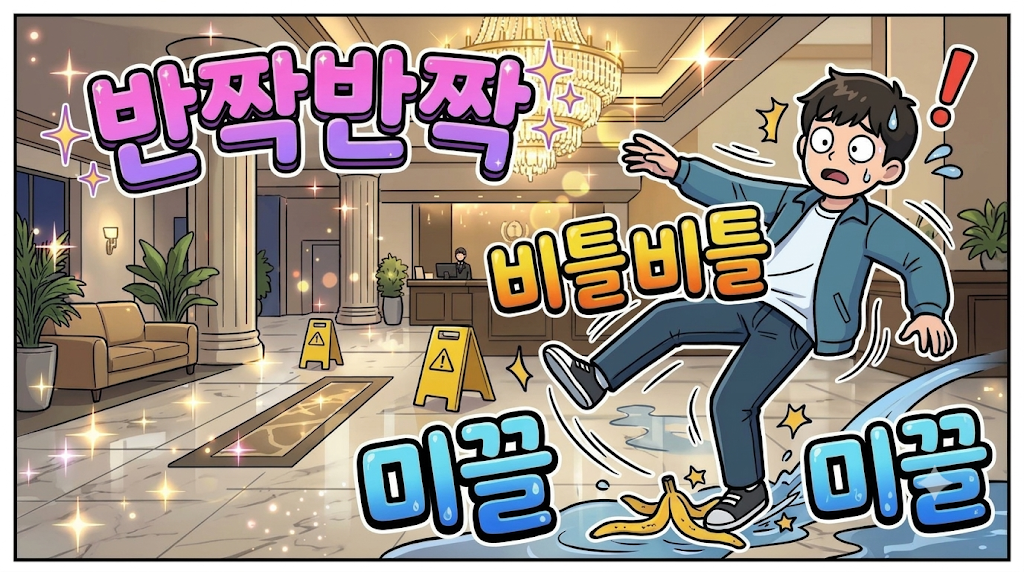
- 반짝반짝 ✨
- Meaning: Describes sparkling, twinkling, or glittering.
- Example: From the nursery rhyme Little Star
“반짝반짝 작은 별 아름답게 비치네”
Twinkle, twinkle, little star, shining so beautifully.
- 비틀비틀 🥴
- Meaning: Describes staggering, swaying, or teetering while walking.
- Example: From the drama Itaewon Class
"넘어질 뻔하고 비틀비틀거려도 상관없어. 방향만 맞으면 결국 목적지엔 도착하니까."
It doesn't matter if I nearly fall or stumble and wobble along. As long as the direction is right, I'll eventually reach my destination.
- 미끌미끌 🧼
- Meaning: Describes something slick, slippery, or slimy.
- Example: From Kok Kok by Apink
"미끌미끌 비누마냥. 꼭 쥘수록 빠져나가.”
Like slippery soap, the tighter I hold on, the more you slip away.
[Bright vs. Dark Sounds ☀️🌙]
Korean onomatopoeia often uses bright and dark vowels to tweak the nuance of a word. Vowels are generally divided into bright/light and dark/heavy categories:
- Bright Vowels: ㅏ (a), ㅗ (o) ☀️ (connote small, light, cute, or bright feelings)
- Dark Vowels: ㅓ (eo), ㅡ (eu), ㅜ (u) 🌙 (connote large, heavy, dark, or serious feelings)
By changing the vowels, you change the "weight" or mood of the word:
💧 ‘졸졸’ vs. ‘줄줄’
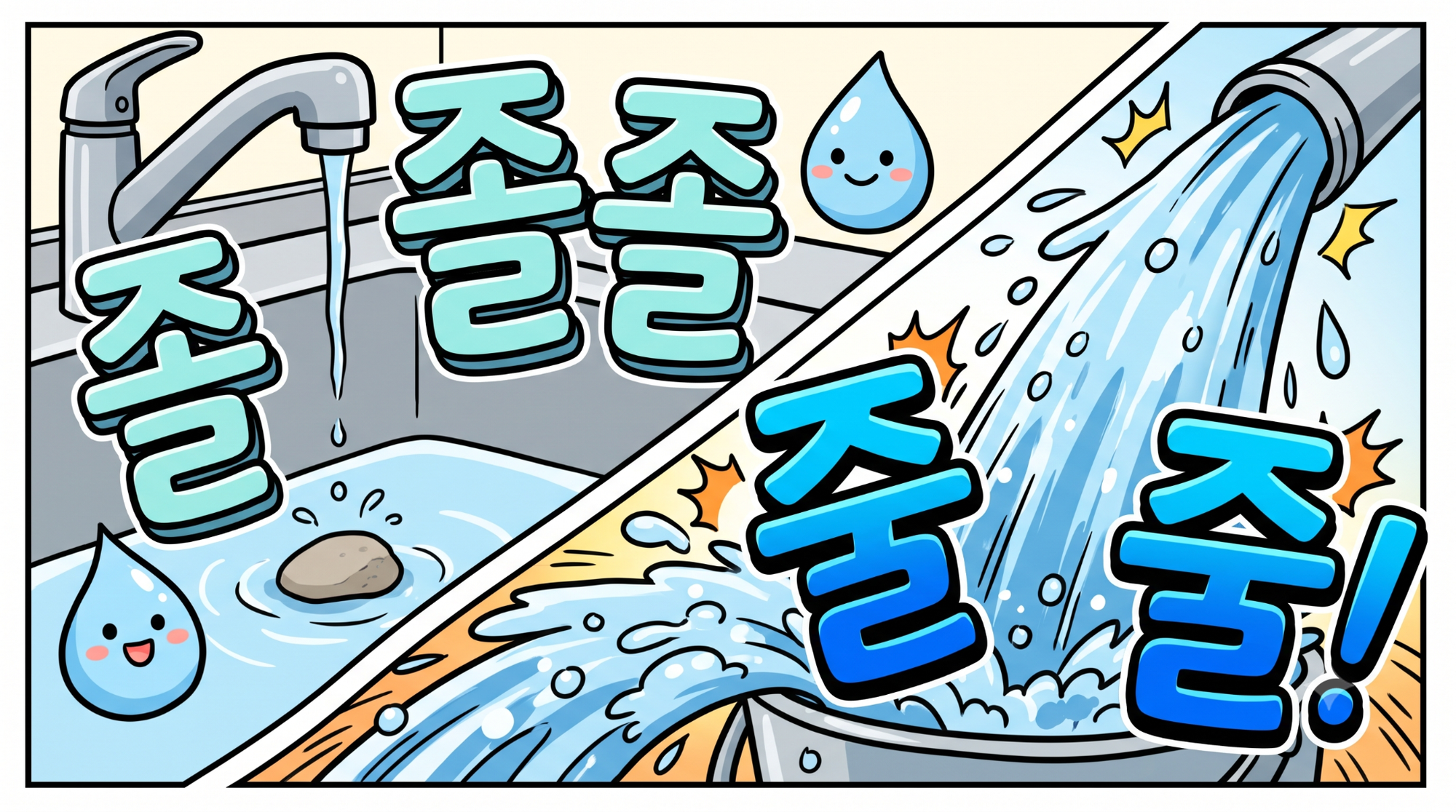
- 졸졸: A light, cute trickle of water.
- Example: From the nursery rhyme Summer Stream
"시냇물은 졸졸졸졸 고기들은 왔다 갔다”
The stream trickles along, the fish swim back and forth.
- Example: From the nursery rhyme Summer Stream
- 줄줄: A heavy, continuous stream or flow of liquid.
- Example: 싱크대를 털었는데 물이 진짜 줄줄 나오네요.
I turned the faucet on, and water is really gushing out.
- Example: 싱크대를 털었는데 물이 진짜 줄줄 나오네요.
🔴 ‘동글동글’ vs. ‘둥글둥글’
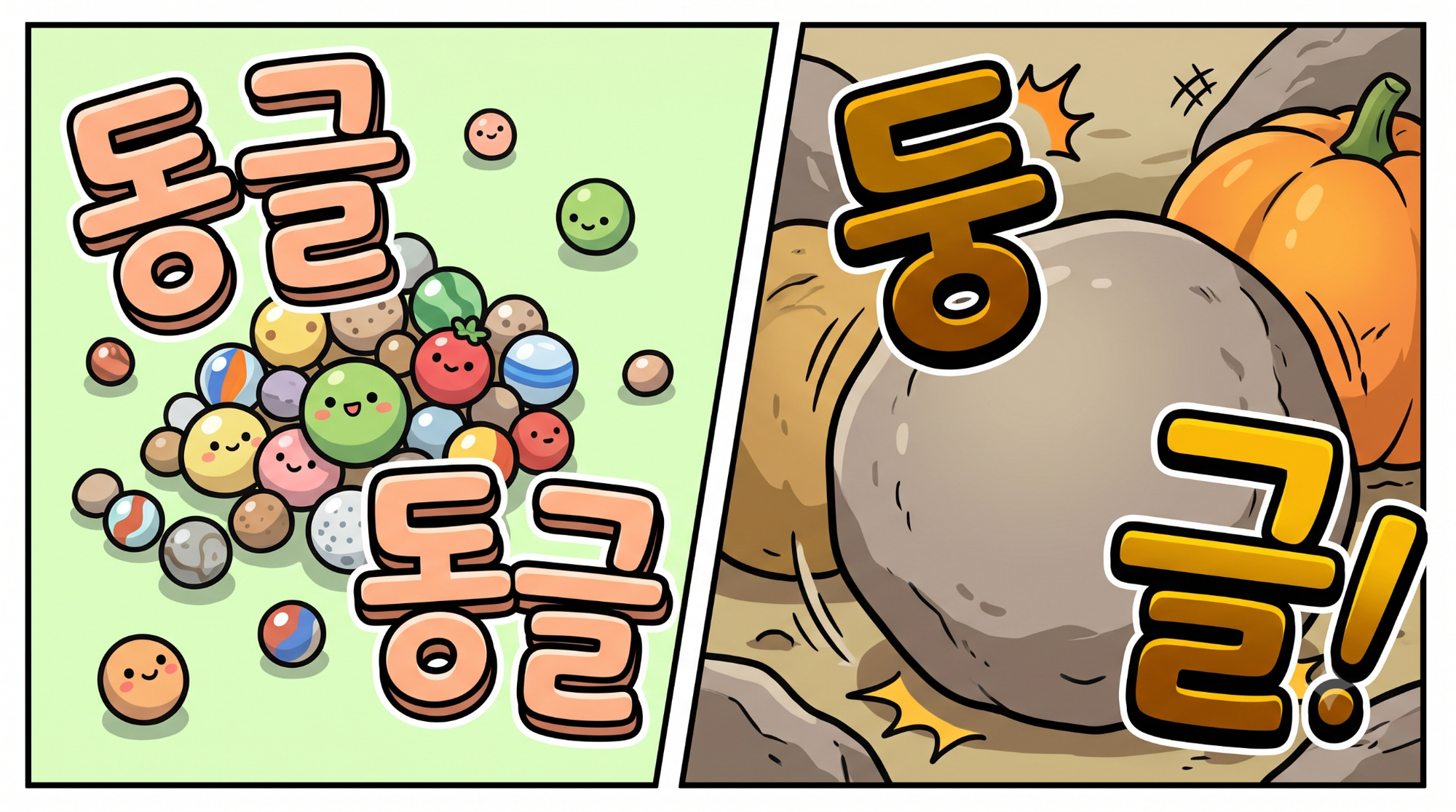
- 동글동글: Describes something round that is tiny, cute, or delicate.
- Example: From the drama Strong Girl Bong-soon
“너 가만 보면 체구도 작고 눈코입도 동글동글해서 되게 땅콩 같거든?”
When I look at you closely, you're petite and your facial features are all round and cute, so you totally look like a peanut, you know?
- Example: From the drama Strong Girl Bong-soon
- 둥글둥글: Describes something round that is bulky, heavy, or smooth/gentle in personality.
- Example: 예쁜 잭 오 랜턴을 만들려면 둥글둥글한 호박을 골라야겠다.
If we want to make a pretty jack-o-lantern, we have to pick out a nice, round pumpkin.
- Example: 예쁜 잭 오 랜턴을 만들려면 둥글둥글한 호박을 골라야겠다.
Why Learn Korean Onomatopoeia? 💡
Korean boasts over 5,000 onomatopoetic expressions, compared to around 1,000 in English! 📈 These expressive words are embedded in daily conversations, webtoons, K-dramas, and music. As an English speaker learning Korean, one of the most fascinating aspects is discovering expressions for concepts that simply don't exist in English. Incorporating them is a fantastic way to elevate your speech and discover new ways to express yourself.
While you don't need to memorize all 5,000, tuning your ear to vowel harmony and context will instantly elevate your Korean and make you sound far more natural! 🗣️
👤 Meet the Author
Lee Siyeon | TTMIK Content Intern 💼
An American student living in Seoul, exploring the subtle nuances between language and culture. Currently navigating Korean workplace etiquette at Talk To Me In Korean!