You’ve probably seen or heard the form -(으)ㅂ시다. However, knowing when and how to use it correctly can make all the difference.
Let's break down what this expression means, when it’s natural, and when it might sound awkward.
🌱 What Is -(으)ㅂ시다?
The Korean ending -(으)ㅂ시다 is used when you want to invite or suggest doing something together — similar to saying “Let’s…” in English.
👉 Example:
- The verb 가다 means to go.
- To say “Let’s go,” attach this ending: 갑시다.

⚠️ When NOT to Use -(으)ㅂ시다
Although it looks formal, -(으)ㅂ시다 isn’t always polite. That might sound confusing — how can something be formal but not polite? It all depends on who you’re talking to.
For instance:
- You shouldn’t use 갑시다 (“Let’s go”) when speaking to your boss or someone older you respect.
- While the form is grammatically formal, it can sound too direct or commanding in those contexts.
So, reserve -(으)ㅂ시다 for the right audience and situation!
✅ When You Can Use -(으)ㅂ시다
Let’s go over some natural and appropriate contexts where this form fits perfectly.
1. When addressing a a large group of people
This form can be used when talking to a large mixed group (younger and older people together). It sounds formal and collective, great for presentations, speeches, or public settings.

2. In titles or written works
This form often appears in book or movie titles because the audience is unknown, but the language is still formal.
3. When being intentionally sharp or sarcastic
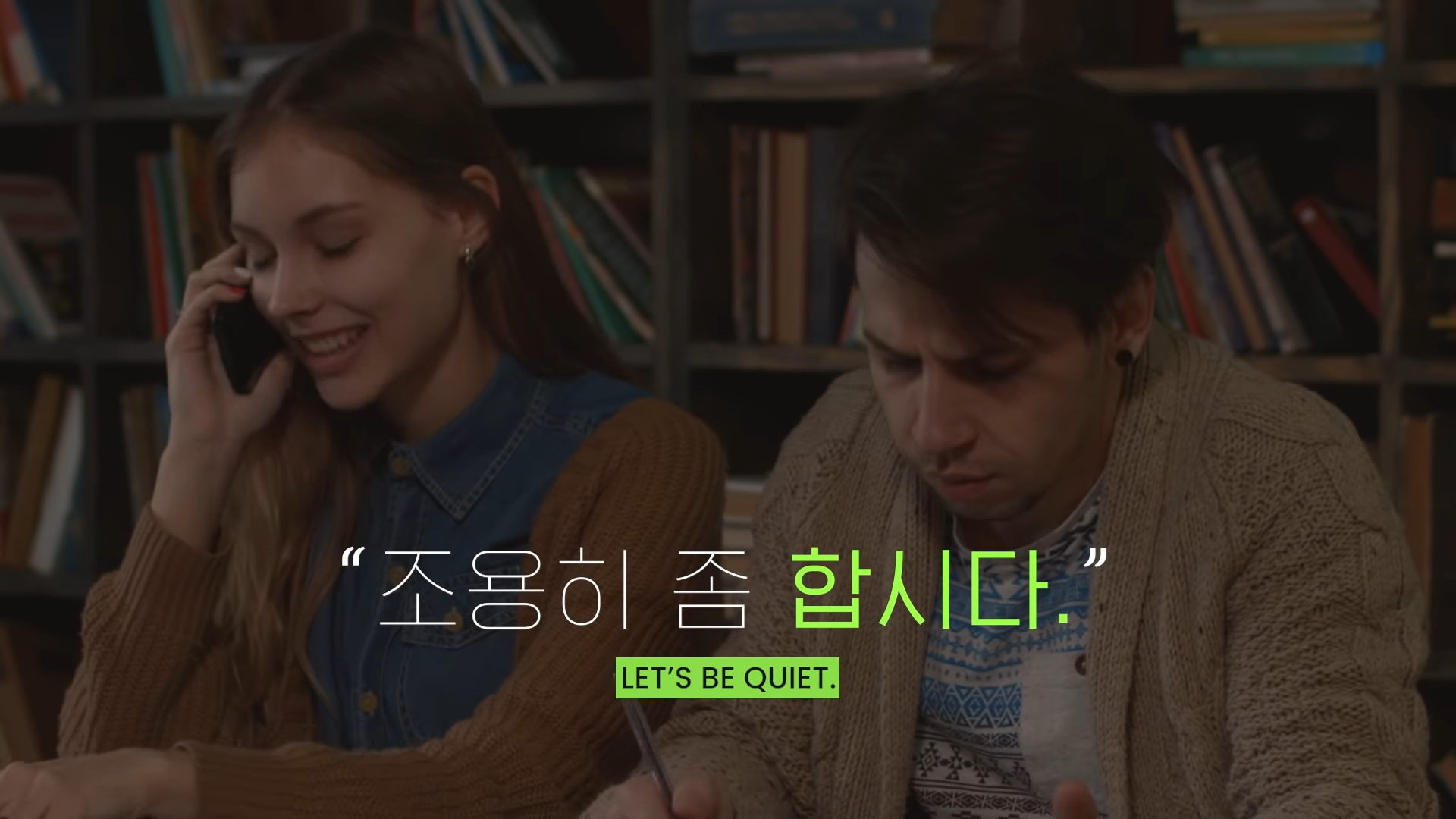
If someone’s being inconsiderate, you can use -(으)ㅂ시다 to express annoyance. For example, imagine you’re at a library and someone is speaking loudly on the phone, disrupting you and others around you.☹️ You may have politely asked this person a few times to end their call, but this is not working.
In this case, you could say 조용히 합시다, meaning “Let’s be quiet,” to impolitely urge them while showing that you are unhappy with their actions.
4. When urging the listener to allow you to do something
In this case, it is similar to “Let me do this” in English. For example, if you’re trying to sleep and those around you are being noisy, you might say 자게 해주세요 (ja-ge hae-ju-se-yo), meaning “Please let me sleep!” This usage can serve as a light command or a result of frustration.
5. In formal writing
This form is most common in written Korean more than in daily speech.
💬 Polite Alternatives to “Let’s…” in Korean
If you want to sound polite and natural, there are better alternatives depending on the situation.
1. Use the present tense
In many cases, simply using the present tense sounds natural and polite enough.
2. Use -시죠 for polite suggestions
Another alternative is the ending -시죠.
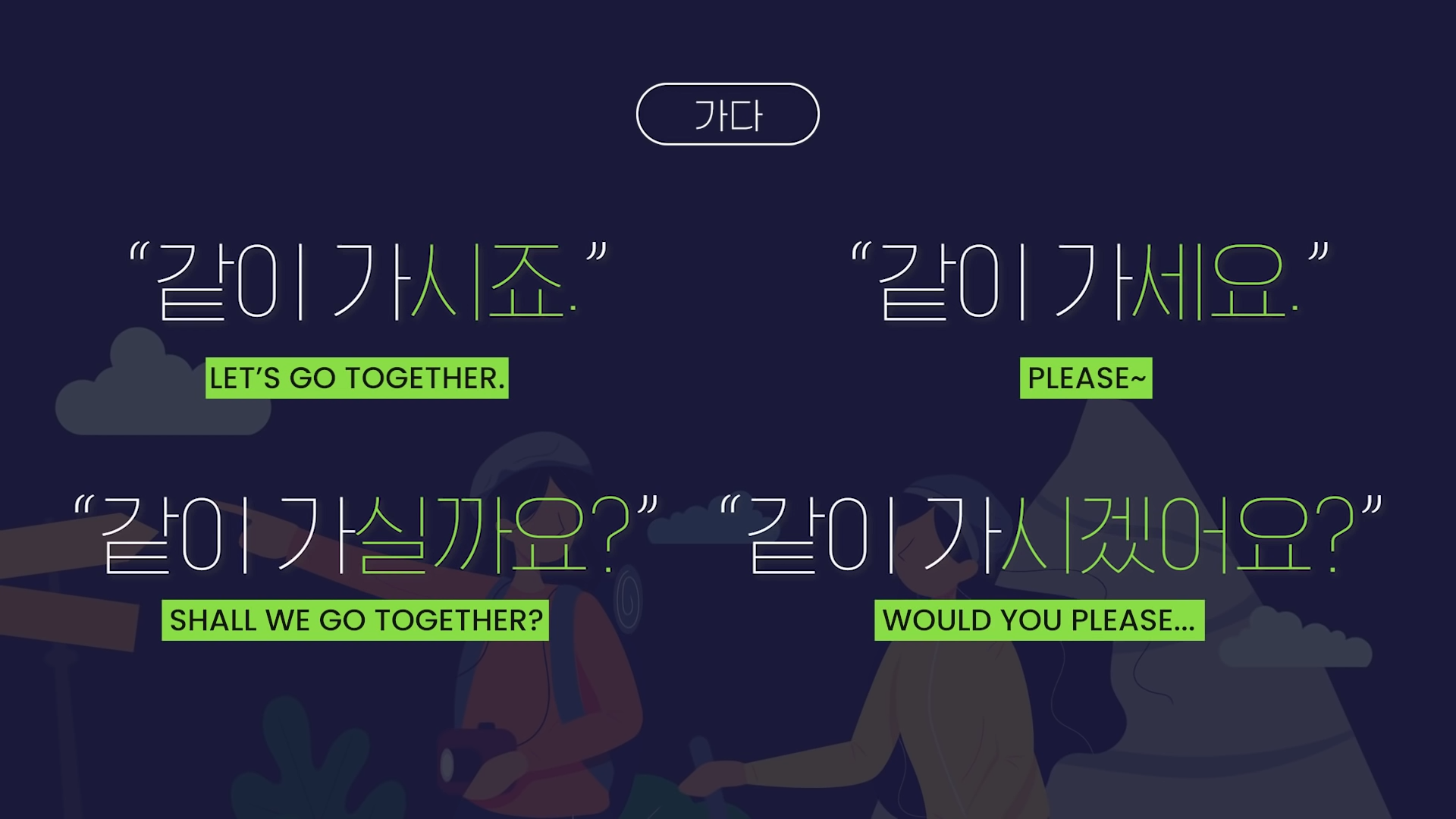
For example, if you were hiking with your teacher and wanted to say “Let’s go,” you would transform the verb 가다 with this ending, creating 가시죠 (kashijyo), which politely urges “Let’s go” and would be appropriate to use toward your teacher or someone of higher position.
You can also enhance this ending by adding more phrases to make the sentence even more polite while still including -시죠 attached to the verb.
Make Progress with us!
Now that you know the ins and outs of -(으)ㅂ시다, you’re one step closer to sounding like a fluent Korean speaker: polite, natural, and expressive.
So, let’s keep learning together with with a trusted curriculum, loved by learners worldwide!