If you’ve been learning Korean for a while, you probably already know that “friend” is commonly translated as 친구.
But here’s something many learners don’t realize:
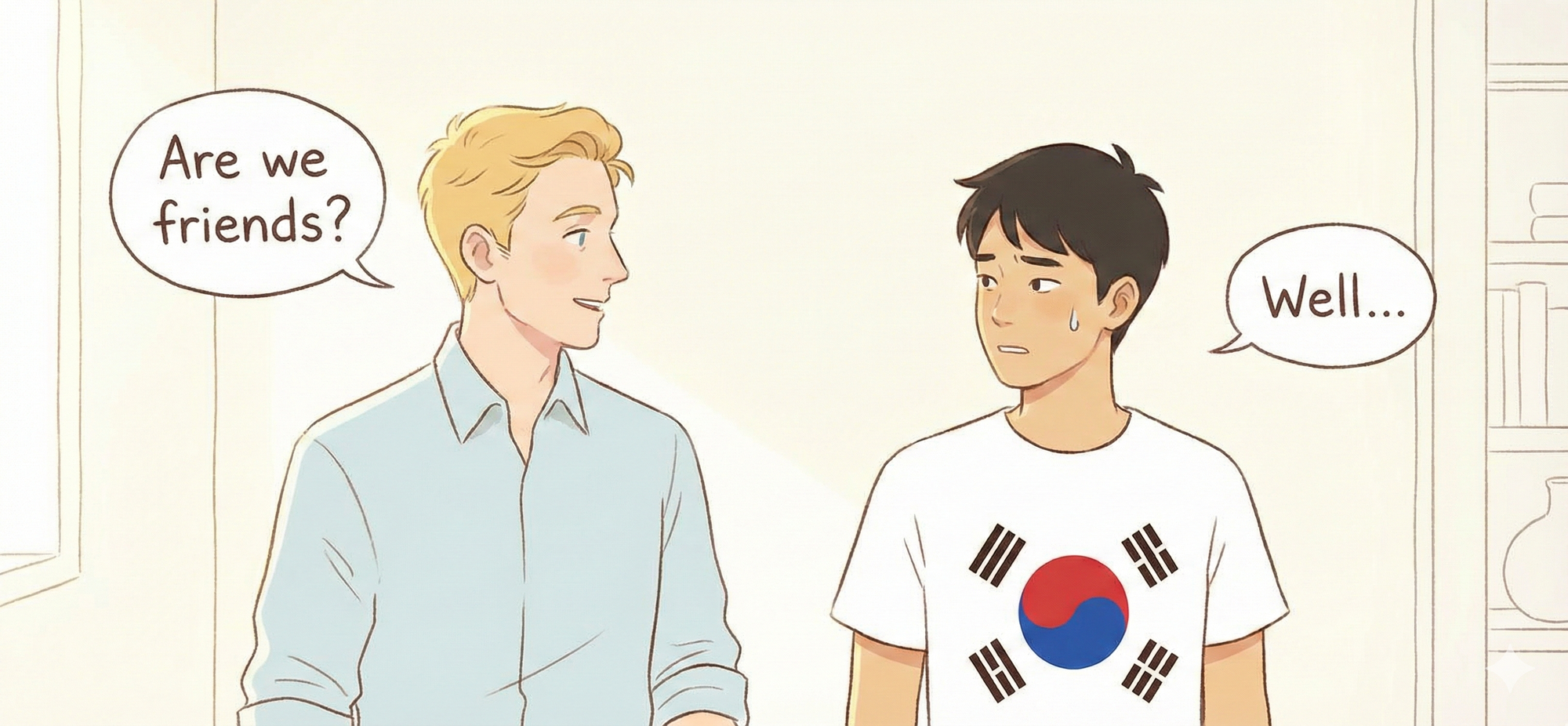
Not everyone you call a “friend” in English can be called 친구 in Korean.
In fact, calling someone 친구 when they’re not the same age as you can create awkward or even rude social situations in Korea.
The Korean Word 친구 Has a Much Narrower Meaning Than “Friend”
In English, friend is a broad, flexible concept.
But in Korean, 친구 is traditionally defined as:
A person who is the same age as you and with whom you speak 반말.
Because Korean culture and language are built around hierarchical relationships, age becomes one of the most fundamental social markers. And this affects how you speak and what you call each other.
Korean even has a specific term for this:
- 동갑내기 친구
- Shortened to 동갑 친구 or simply 동갑
Only people in this category typically call each other by name + 아/야 (현우야, 승완아).
Doing this to someone older than you is considered disrespectful.
So, while English uses “friend” very liberally, Korean uses 친구 far more selectively.

반말 vs 존댓말
Depending on your age difference, you may speak:
- Mutual 반말 (informal)
- 반말 → 존댓말 (you are older)
- 존댓말 → 반말 (they are older)
- Mutual 존댓말 (formal or unclear relationship)
Of these four, only the first scenario typically allows the relationship to be labeled 친구.
If Not 친구, Then What?
Korean has many relationship titles that carry nuance depending on age, closeness, and context. Instead of forcing 친구, Koreans might say:
- 지인: an acquaintance
- 아는 사람: someone I know
- 아는 형/오빠/누나/언니: someone I know who's older than me
- 아는 동생: someone I know who's younger than me
- 선배 / 후배: someone older/younger than me who I used to belong to the same school/team/organization
- 친한 지인: a close acquaintance
- 동창: schoolmate
These titles do not automatically indicate how emotionally close two people are.
They are simply more socially accurate and polite.
How Modern Koreans Are Redefining “Friendship”
The traditional definition still exists, but Korea is changing.
More Koreans:
- use 친구 more flexibly
- consider people of different ages as friends
- don’t tie “friendship” strictly to 반말
- adopt broader definitions influenced by other languages
- resist rigid age hierarchies
For example, two coworkers who always speak in 존댓말 may still describe each other as close friends when speaking broadly.
Did you get a sense of it now?
The meaning of “friend” in Korean can be tricky, but it is definitely something worth knowing!
We’ll be back with another fun topic next time, so stay tuned!
If you want to learn more Korean or find the study method that fits you best,
visit our Brand Page and start your learning journey today!
From the first word to advanced fluency
Find the perfect learning tools, from comprehensive courses to interactive apps,
all customized to fit how you learn best.
Want to learn to speak Korean with our
systematic curriculum?